
Oral-B vs Sonicare: what actually differs
Five handles compared from their own Amazon listings: two entry models at about $50 and three flagships. We lay the spec sheets side by side; this is a comparison of listed features, not a lab test.
Short answer. For most people the choice is the Oral-B Pro 1000 ($49.94) versus the Philips Sonicare 4100 ($49.96): near-identical price, so decide on features. The Oral-B has a round brush head and stops its pulsations if you press too hard; the Sonicare uses sonic technology, pulses the handle as a warning and lasts up to 14 days per charge. Spend more only for the app, extra modes or a display.
Prices and availability read from Amazon on October 7, 2026 and change without notice. We earn a commission if you buy through our links, which costs you nothing and is the only way this site makes money.
| # | Toothbrush | Role | Defining feature | Price |
|---|---|---|---|---|
| 1 | Oral-B Pro 1000 Rechargeable Electric Toothbrush | Oral-B entry model | Round head, pressure control | $49.94 |
| 2 | Philips Sonicare 4100 Rechargeable Electric Toothbrush | Sonicare entry model | Sonic, pressure sensor, 14 days | $49.96 |
| 3 | Oral-B iO Deep Clean + Protect, iO Series 7 | Oral-B mid-range | 5 modes, app, pressure sensor | $229.99 |
| 4 | Oral-B iO10 Ultimate Clean Rechargeable Electric Toothbrush | Oral-B top model | 7 modes, display, iOSENSE charger | $249.99 |
| 5 | Philips Sonicare 9900 Prestige Electric Toothbrush | Sonicare top model | SenseIQ, 15 settings, app | $335.02 |
Oral-B Pro 1000 Rechargeable Electric Toothbrush
Oral-B entry model

$49.94
The Oral-B model to compare against the Sonicare 4100: same price tier, round brush head, and a handle that stops the brush pulsations when you press too hard.
Strengths
- Pressure control acts on its own: the listing says pulsations stop when brushing too hard
- Quadrant timer built into the handle
- Oral-B brush heads for different needs are sold separately, per the listing
Trade-offs
- The listing mentions no app and no battery-life figure
- Brush heads are a separate purchase for non-standard needs
Philips Sonicare 4100 Rechargeable Electric Toothbrush
Sonicare entry model
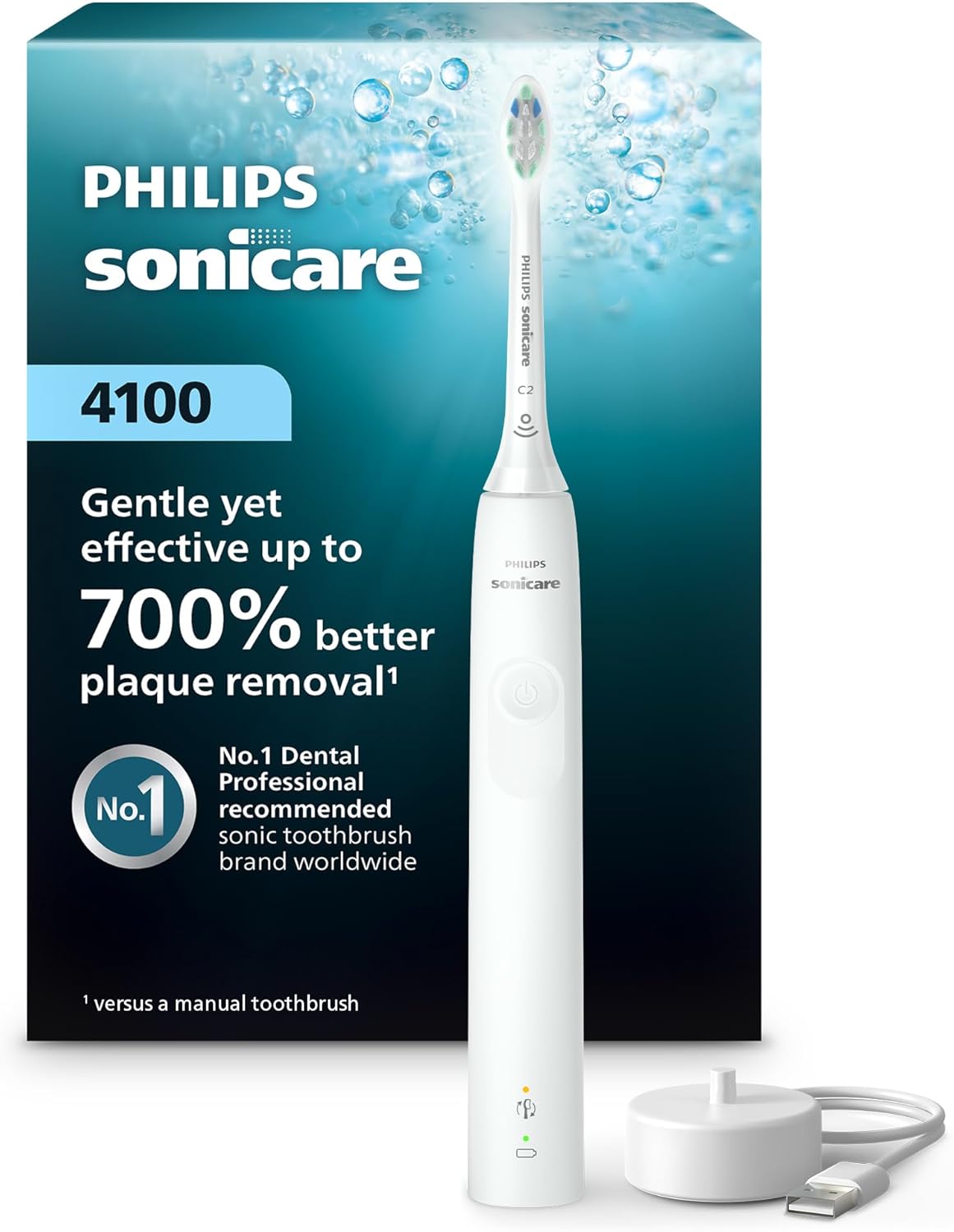
$49.96
The Sonicare model to compare against the Oral-B Pro 1000. Its pressure feedback is a pulse in the handle rather than an automatic stop.
Strengths
- EasyStart ramps power up gradually, which suits a first electric brush
- Up to 14 days per charge per the listing
- Brush head replacement reminder
Trade-offs
- Power adaptor is not included, only a USB charger
- The listing mentions no app connection
Oral-B iO Deep Clean + Protect, iO Series 7
Oral-B mid-range

$229.99
A mid-range iO with the app tracking and a travel case that doubles as a charger.
Strengths
- Five modes and app coverage tracking
- Light ring signals pressure and the 2-minute timer
- Travel case with built-in charger
Trade-offs
- Several times the price of the entry models
- Compatible with round replacement brush heads, per the listing
Oral-B iO10 Ultimate Clean Rechargeable Electric Toothbrush
Oral-B top model

$249.99
The top Oral-B on this page, with a display and a charger that shows brushing guidance without opening the app.
Strengths
- Guidance on the charger itself, no phone needed
- Four brush heads included
- Display tracks battery level
Trade-offs
- Most expensive Oral-B listed here
- Features beyond the pressure sensor add cost, not necessarily better cleaning
Philips Sonicare 9900 Prestige Electric Toothbrush
Sonicare top model

$335.02
Philips’s top handle in this comparison, where the toothbrush adjusts its own intensity when you press too hard.
Strengths
- Adjusts intensity itself instead of only warning you
- 15 settings across 5 modes and 3 intensity levels
- Light ring at the base warns about pressure
Trade-offs
- Priciest handle on this page
- Includes 1 brush head per the listing title
Round head or sonic: what is the real difference?
Oral-B listings describe a round brush head that, in Oral-B’s words, reaches where rectangular manual brushes do not. Philips describes Advanced Sonic Technology that pulses fluid between teeth and along the gumline, and on the 9900 up to 62,000 bristle movements per minute. Those are the brands’ own descriptions. The listings do not give a head-to-head cleaning result, so choose the head shape you find comfortable.
How does pressure protection compare?
Every handle here warns about heavy brushing, in four ways. The Oral-B Pro 1000 automatically stops brush pulsations when you press too hard. The Sonicare 4100 pulses slightly to remind you to ease off. The Oral-B iO models signal if you brush too hard, too soft or just right. The Sonicare 9900’s SenseIQ lowers the intensity itself. If you tend to scrub, an automatic response is more forgiving than a warning.
What do the extra dollars buy?
Moving from about $50 to $230-$335 buys app tracking, more cleaning modes (5 on the iO7, 7 on the iO10, 15 settings on the Sonicare 9900), a display or light ring, and a travel case. The two entry models cover timers, pressure feedback and a rechargeable battery. Pay for the upgrade only if you will use the app or want a specific mode.
Timers and brushing pace
The Oral-B Pro 1000 has a handle-integrated quadrant timer that alerts you every 30 seconds to change zones. The Sonicare 4100 offers a SmarTimer that signals when you have reached 2 minutes and a QuadPacer that prompts a new section every 30 seconds. The iO7 uses a light ring timer that keeps to the two-minute brushing time.
Battery and travel
The Sonicare 4100 lists up to 14 days of regular brushing per charge and the Oral-B iO7 lists a charge of up to 2 weeks, with a built-in charger travel case. The Oral-B Pro 1000, iO10 and Sonicare 9900 listings do not state a battery duration in the text we read, so we make no claim for them.
Brush heads and replacement reminders
The Sonicare 4100 and 9900 listings both mention a brush head replacement reminder, and the iO7 lists a refill change alert. Oral-B’s Pro 1000 listing notes brush heads for different needs are available for purchase separately. Check head compatibility before buying refills: for example, the Bitvae listing says its heads fit Oral-B handles except iO.
Want a cheaper pick? See our best affordable electric toothbrushes, or the full electric toothbrush guide. Pair a brush with a water flosser for the complete routine.
Is Oral-B or Sonicare better?
Neither wins on every point. Oral-B uses a round brush head; Sonicare drives bristles with sonic technology. At about $50, the Oral-B Pro 1000 and Sonicare 4100 sit within two cents of each other, so pick on feel and on features: automatic pressure stop (Oral-B Pro 1000) or EasyStart and a 14-day charge (Sonicare 4100).
Which is cheaper to run, Oral-B or Sonicare?
Both brands sell replacement heads separately, and the Amazon listings do not give a per-head price, so we cannot rank running cost. Check the head you would need before you buy the handle.
Do these toothbrushes have a pressure sensor?
Yes, on every model compared here, but it behaves differently. The Oral-B Pro 1000 stops pulsations, the Sonicare 4100 pulses the handle, the iO models signal too hard, too soft or just right, and the Sonicare 9900 reduces intensity on its own.
Is a more expensive electric toothbrush worth it?
The listings show what the extra money buys: app tracking, more modes, a display, a travel case charger. They do not show that it cleans better than the entry models, so treat the price gap as a features gap.